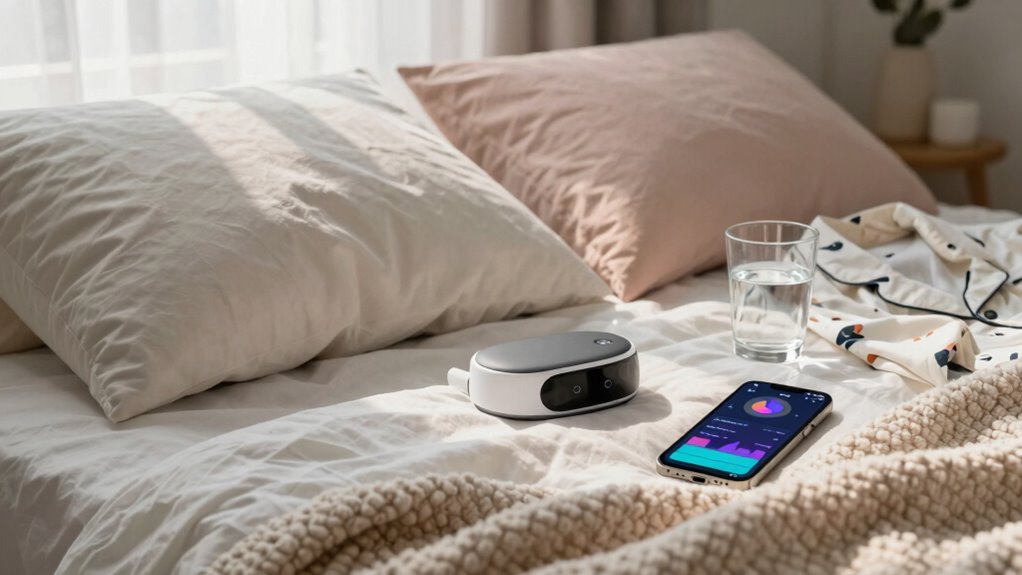

Sleep trackers can give you helpful insights into your sleep patterns and help increase awareness of your habits, but they aren’t perfect. They mostly analyze movement and heart rate, so they can oversimplify sleep stages and may show you’re getting enough deep sleep when that isn’t accurate. While useful for tracking trends over time, they shouldn’t replace professional sleep evaluations. Keep exploring to understand what these devices can truly tell you—and their limitations.
Key Takeaways
- Sleep trackers estimate sleep stages based on movement and heart rate, but lack clinical-grade sensors for accuracy.
- They can identify patterns and trends but cannot diagnose sleep disorders or provide definitive health assessments.
- Data accuracy is limited and may oversimplify sleep quality, so results should be interpreted cautiously.
- Privacy concerns exist as trackers often store sensitive data in the cloud, which may be shared or sold.
- These devices are useful for awareness and motivation but should not replace professional medical advice or evaluations.
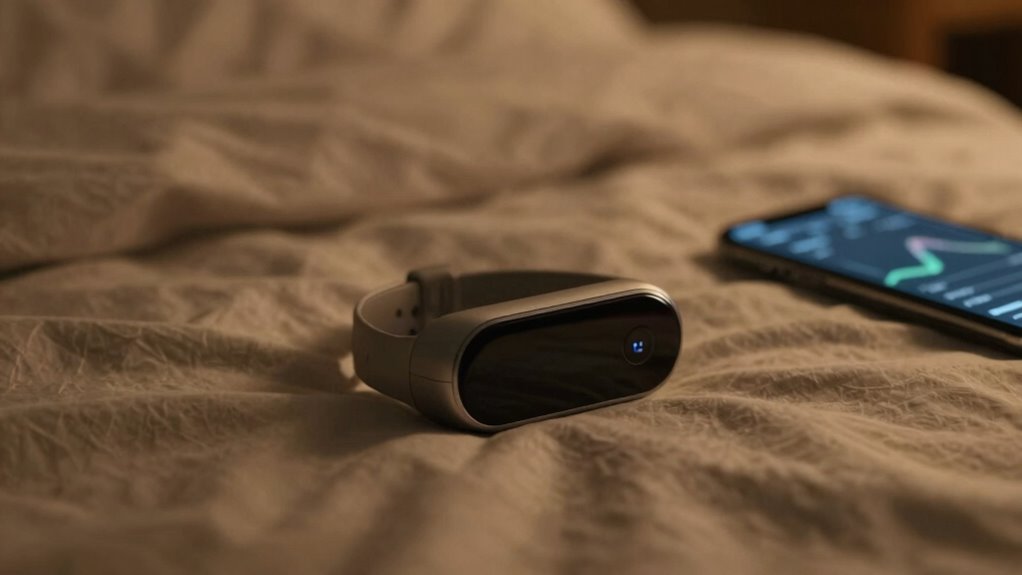
In today’s world, sleep trackers have become popular tools for monitoring your nightly rest, but understanding their true capabilities can be confusing. These devices, whether worn on your wrist or embedded in your mattress, aim to give you insights into your sleep patterns, but they’re not foolproof. One of the key features they offer is sleep cycle analysis, which attempts to break down your sleep into stages like light, deep, and REM sleep. While this can be helpful for spotting general trends, it’s important to remember that most consumer-grade devices rely on movement and heart rate data to estimate these stages. They don’t have the sophisticated sensors used in clinical sleep studies, so their analysis can sometimes be inaccurate or oversimplified.
Sleep trackers estimate sleep stages using movement and heart rate, but their accuracy is limited compared to clinical studies.
When it comes to sleep cycle analysis, you might find that your tracker reports you’re getting enough deep sleep, but in reality, your sleep quality could still be compromised by other factors like disruptions or underlying health issues. The data can serve as a useful starting point, but it shouldn’t replace professional advice or thorough sleep evaluations. It’s also worth considering that these devices often provide daily or weekly summaries that help you identify patterns over time, but individual nights can sometimes be misrepresented. If you notice irregularities, don’t jump to conclusions—use this information as a general guide rather than a definitive diagnosis. Additionally, understanding data accuracy is crucial for interpreting what your sleep tracker reports, as many devices have limitations that can affect their reliability. Knowing how measurement methods impact the results can help you better assess the data’s significance. Moreover, being aware of user data privacy concerns can help you make informed choices about which device to trust with your sensitive information.
Another critical aspect to keep in mind is user data privacy. Sleep trackers collect sensitive personal information, including sleep duration, heart rate, activity levels, and sometimes even location data. Many companies store this data in the cloud, which raises concerns about how securely your information is protected and whether it might be shared with third parties. It’s also useful to recognize that accuracy limitations are common among consumer devices, which underscores the importance of viewing the data as a helpful tool rather than an exact measurement. Always read privacy policies carefully and be cautious about granting permissions. You want to ensure that your sleep data isn’t being used for targeted advertising or sold to marketers without your consent. Choosing reputable brands that prioritize user data privacy can help safeguard your information, but no device is immune to potential breaches or misuse.
Furthermore, requirements traceability is essential for ensuring compliance with standards like FedRAMP, which emphasizes the importance of understanding data collection, storage, and sharing practices to protect user information. Being aware of such standards can help you evaluate the security measures implemented by different devices and companies.
Ultimately, sleep trackers can provide valuable insights and motivate you to improve your habits, but they’re not a substitute for professional sleep medicine or medical advice. They’re best used as tools for awareness rather than definitive sources of truth. By understanding their limitations—particularly around sleep cycle analysis and user data privacy—you can make smarter decisions about how much trust to place in these devices and how to incorporate their insights into your overall health and wellness routines.
best sleep tracker with heart rate monitoring
As an affiliate, we earn on qualifying purchases.
As an affiliate, we earn on qualifying purchases.
Frequently Asked Questions
Can Sleep Trackers Diagnose Sleep Disorders?
Sleep trackers can’t diagnose sleep disorders because of their limitations. They mainly monitor sleep patterns, but only a healthcare professional can provide an accurate diagnosis. Keep in mind, sleep tracker limitations include sometimes inaccurate data or missing subtle issues. Also, be aware of privacy concerns, as your sleep data might be shared or stored insecurely. Always consult a doctor if you suspect a sleep disorder rather than relying solely on a tracker.
How Accurate Are Sleep Trackers for Different Age Groups?
You might worry about age-related accuracy of sleep trackers, but most devices are fairly reliable across different age groups, thanks to ongoing device calibration. While younger users often get precise data, older adults may notice minor discrepancies due to unique sleep patterns. Overall, these trackers provide useful insights, but keep in mind that individual differences and device calibration can influence their accuracy for your specific age group.
Do Sleep Trackers Work Without Consistent Usage?
Sleep trackers work best with consistent usage because device calibration and user compliance are vital. If you wear the device regularly, it can accurately monitor your sleep patterns over time. Inconsistent use might lead to inaccurate data, making it harder to identify trends or get reliable insights. So, to get the most out of your sleep tracker, stick to a routine and guarantee the device fits well.
Can Sleep Trackers Predict Future Sleep Problems?
Sleep trackers can’t predict future sleep problems precisely, but they can give you clues about your sleep quality and consistency. By monitoring patterns over time, they help you identify signs of irregular sleep or declining sleep quality. While they don’t forecast issues, paying attention to these trends encourages you to make healthier sleep choices, potentially preventing future problems. Consistent use enhances their usefulness in tracking your overall sleep health.
Are Sleep Tracker Insights Sufficient for Medical Advice?
Sleep tracker insights alone aren’t enough for medical advice because of their limitations. They can help identify patterns but don’t diagnose conditions or consider your unique health history. Relying solely on them risks overlooking underlying issues. Plus, be mindful of sleep tracker limitations and user privacy concerns, since some data might be shared or stored insecurely. Always consult a healthcare professional for anything serious or persistent.
Conclusion
While sleep trackers offer helpful insights into your sleep patterns, they aren’t perfect. Don’t rely solely on them to diagnose sleep issues or replace medical advice. Think of them as a helpful map, guiding you toward better habits, but not the entire journey. If you see inconsistent data, don’t get discouraged—imagine a fog lifting as you improve your sleep routine. Trust your instincts and consult a healthcare professional for a clearer picture of your sleep health.