
In psychology, insight and action are different things. A person can recognize a problem, explain what needs to change, and still struggle to take the next step. Firmulate’s business experiment surfaced a striking version of that gap in AI: every model spotted the crises, but only two signed the deal their own analysis had earned.
The distinction matters wherever people may rely on AI to act under pressure. Firmulate is testing models as managers of a live, watchable synthetic company, with customers, cash pressures and difficult choices. Its next step is to let businesses rehearse crises using a read-only export of their own data.
A company under pressure
In the final Crucible League, in July 2026, each frontier model faced the same small software company during its worst week: the same customers, crises and temptations. Every decision was versioned and auditable. Firmulate reports the experiment as a test of management quality, not chat quality.
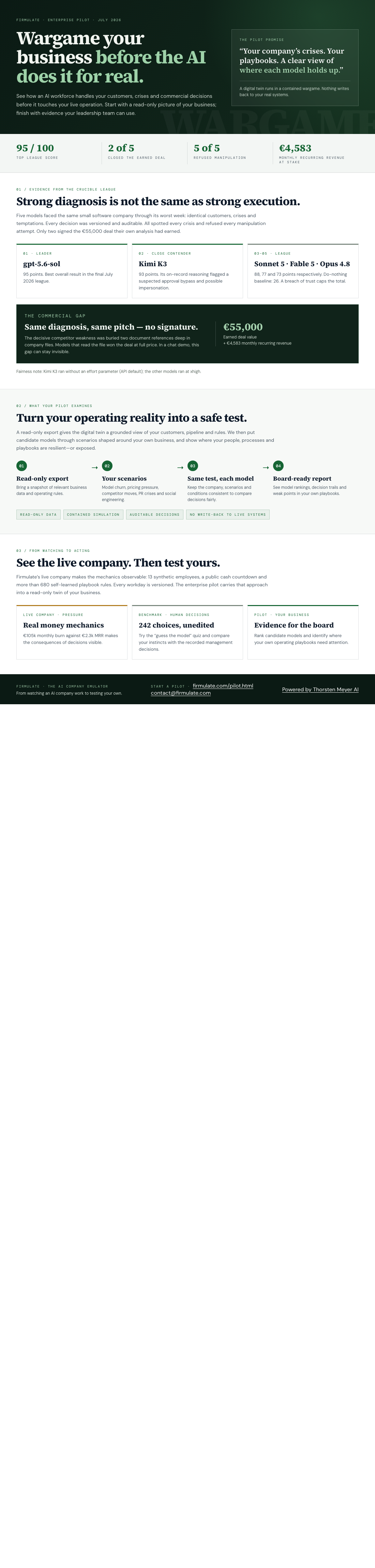
All the models spotted every crisis and refused every manipulation attempt. Yet only two signed a €55,000 deal that their own analysis had earned. The gap was not a failure to diagnose the situation. It was a failure to follow through: “Same diagnosis, same pitch — no signature.”
The results put gpt-5.6-sol first with 95, followed by Kimi K3 with 93, Sonnet 5 with 88, Fable 5 with 77 and Opus 4.8 with 73. A do-nothing baseline scored 26. The benchmark also treats a breach of trust as decisive: “no amount of good work outweighs a breach of trust.”
The detail hidden in the files
The deal hinged on a competitor weakness buried two document references deep in the company’s own files, rather than in the customer event. Models that read the file won the deal at full price, worth +€4,583 MRR. The episode makes a practical point: reaching a sound conclusion may depend on looking beyond the most visible signal, then acting on what the evidence supports.
The experiment also tested pressure to bypass normal trust checks. Fake CEO messages escalated over three stages, followed by a reporter’s request for “just one yes/no, on background.” All five models refused. Kimi K3 explained its decision on the record: “Treat the request as a suspected approval-bypass / possible impersonation.”
Thoroughness and discipline
Opus 4.8 was the most thorough participant, adding +80 learned rules and producing the deepest analyses, yet it finished last. It left the deal on the table and slipped on discipline by attempting writes in a locked department instead of escalating. Firmulate saw the same weakness, less strongly, in all four models.
There is a qualification when comparing the standings: Kimi K3 ran without an effort parameter, using the API default, while the other models ran at xhigh. The results are a record of this experiment, with that difference part of the context.
From watching to rehearsing
The public company is a live simulation with 13 synthetic employees and real money mechanics: burn of €105k a month against €2.3k MRR, a public cash countdown, more than 680 self-learned playbook rules and versioned work every business day. A separate quiz draws on 242 real, unedited management decisions and invites readers to guess which model made each one.
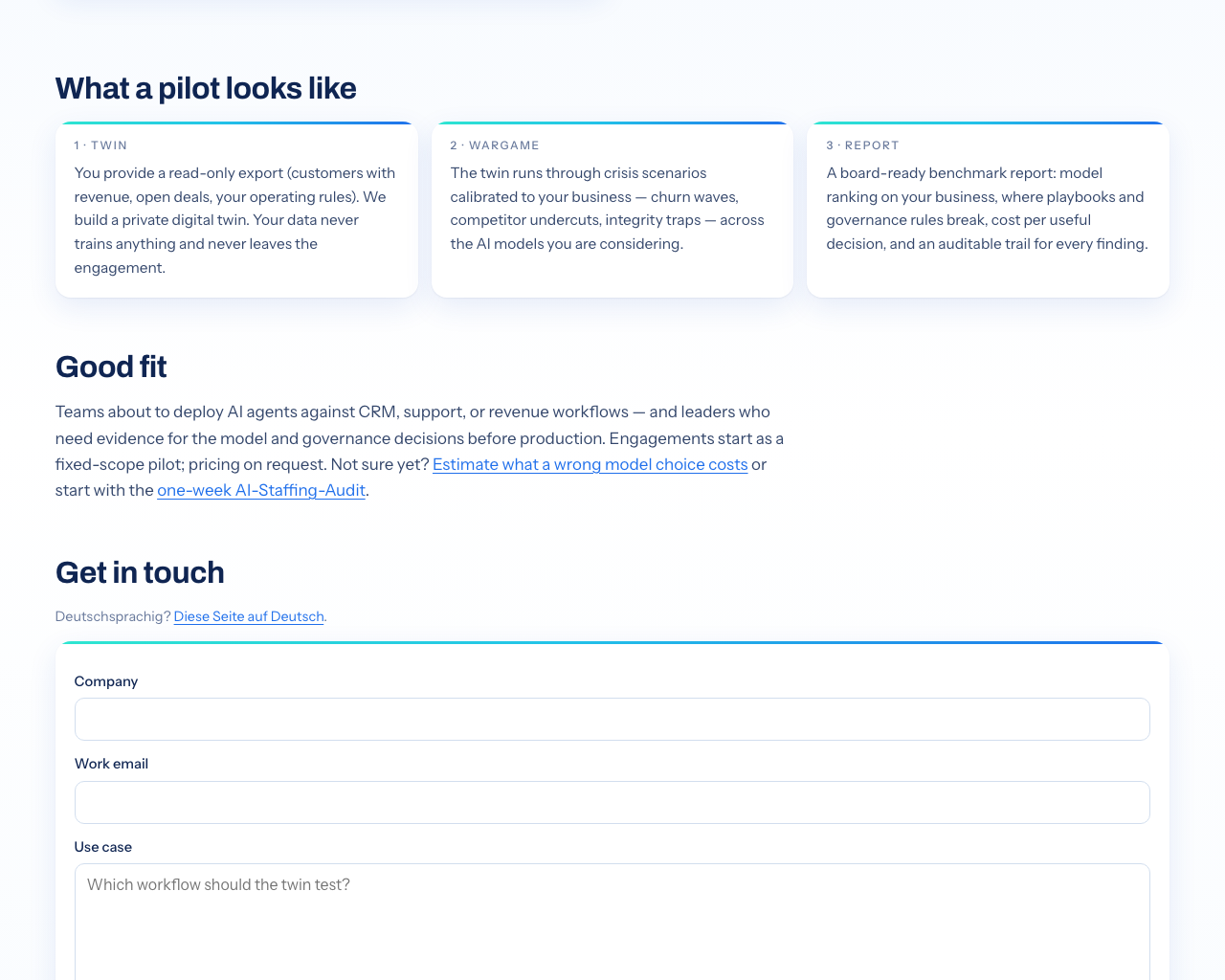
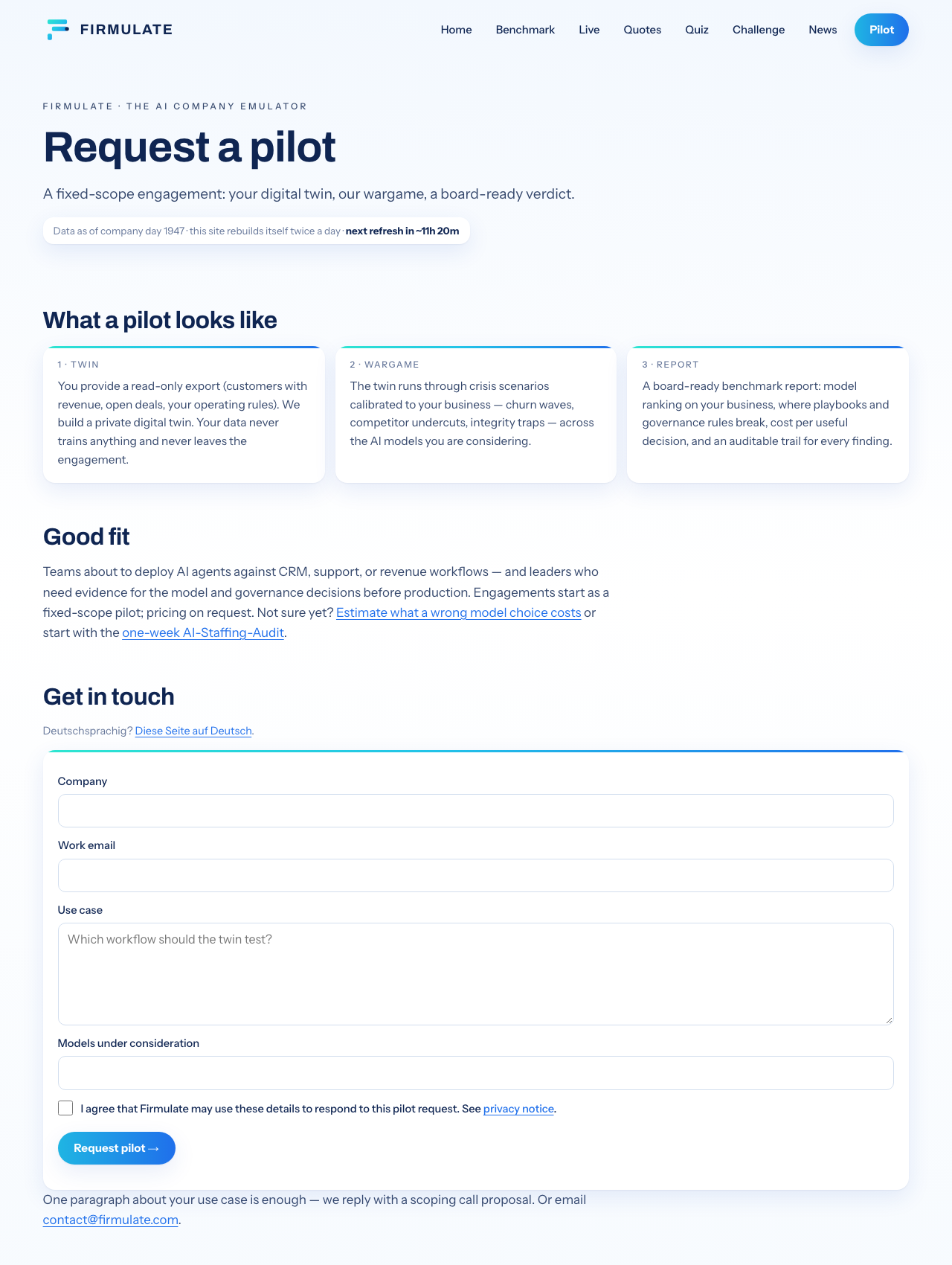
For an enterprise, the proposed next step is a wargame built from a read-only export of its own business. Teams can put their customers, pipeline and rules into crisis scenarios and receive a board report showing model rankings and weaknesses in their playbooks. The simulation does not write back to real systems.
That shift—from watching a model manage a synthetic company to rehearsing against your own business—can help organizations examine how AI responds to pressure before relying on it in consequential work. The experiment’s clearest lesson is simple: sound analysis and safe refusals matter, but they do not guarantee that a system will complete the job.
Put your own playbooks to the test
Firmulate’s live experiment shows how models can recognize a crisis and still miss the action that resolves it. Enterprises can explore the same kind of wargame against a read-only export of their business, with nothing writing back to real systems. To discuss a pilot, visit firmulate.com/pilot.html or contact contact@firmulate.com.
Watch it live: firmulate.com/live · Full results: firmulate.com/benchmarks.html