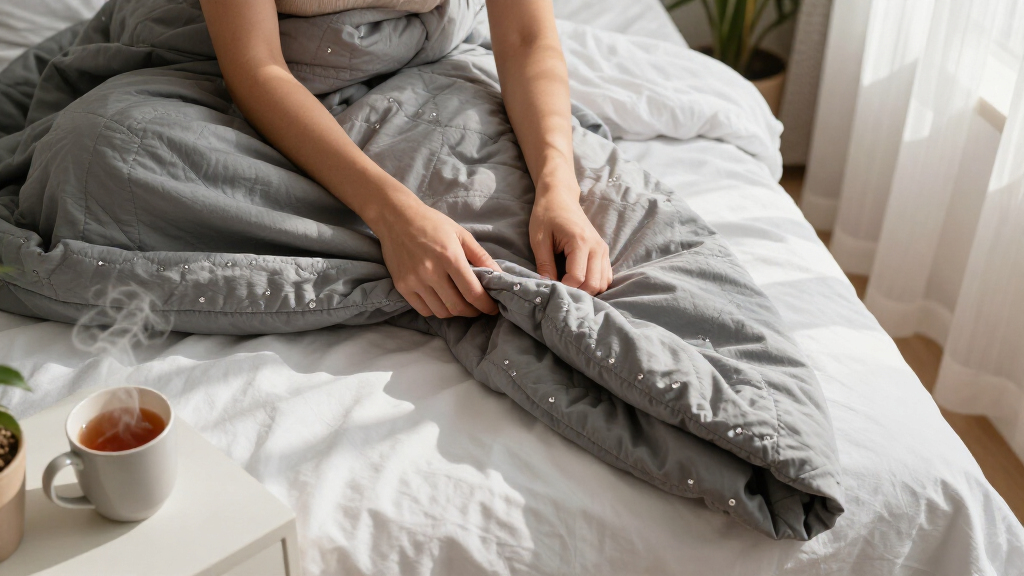

Weighted blankets work through deep-pressure stimulation — a gentle, distributed weight that calms the nervous system and can lower anxiety enough to help you fall asleep. That mechanism is physics, not brand magic, which is exactly why the budget-versus-premium question trips people up. A $40 blanket and a $250 blanket both weigh 15 pounds and both press down on your body. So what are you actually paying for, and does it change how well the blanket works for anxiety?

Turn your wind-down time into listening time
- Thousands of audiobooks, podcasts and originals
- Listen on your phone, tablet or Echo — also offline
- Cancel anytime

yescool Weighted Blanket for Adults, 20 lbs, Queen Size (60" x 80"), Grey
- ✔ Weight: 20 lbs
- ✔ Size: Queen (60" x 80")
- ✔ Color: Grey

Mr. Sandman Cooling Weighted Blanket for Adults, Queen Size 15 lbs, 60"x80"
- ✔ Weight: 15 lbs
- ✔ Size: Queen (60" x 80")
- ✔ Fill Material: Glass beads

L’AGRATY Weighted Blanket for Adults, 15 lbs, 48"x72", Dark Grey Twin/Full Size
- ✔ Weight: 15 lbs
- ✔ Size: 48" x 72" (twin/full)
- ✔ Color: Dark grey
The honest answer: the therapeutic effect is largely similar, but the experience around it is not. Budget blankets tend to use glass beads that shift, pocket, and rustle inside rougher fabric that traps heat and may degrade after a year of washing. Premium blankets — knitted designs like Bearaby or engineered pocket systems like Gravity and Baloo — distribute weight more evenly, run quieter, breathe better, and hold up longer. The real decision is whether you are buying a trial tool to see if weighted therapy helps you at all, or investing in a nightly-use sleep product you will live under for years. This guide compares both sides across the criteria that actually affect anxiety relief and daily comfort so you can decide which tier fits you.
At a Glance
| Criteria | Budget weighted blanket (~$30–60) | Premium weighted blanket (~$150–250) | Winner |
|---|---|---|---|
| Anxiety relief effectiveness | Same deep-pressure benefit when weight is correct | Same deep-pressure benefit, slightly more consistent pressure | Tie |
| Weight distribution and pocketing | Cheaper pocket stitching; beads can shift and pool | Evenly distributed — knitted layers or dense pocket grids | B |
| Fabric and breathability | Basic microfiber or Minky; traps heat | Cotton, Tencel/lyocell, or chunky-knit yarn; breathes well | B |
| Noise during movement | Noticeable bead rustle when moving | Nearly silent, especially knitted styles | B |
| Durability and washing | Seams and stitching often fail within 1–2 years | Built for years of washing; often better warranties | B |
| Temperature for hot sleepers | Poor; most hot sleepers overheat | Good, especially cotton and open-knit designs | B |
| Size, weight and color options | Limited weights and a few colors | Wide weight range, multiple sizes and colors | B |
| Price | $30–60 | $150–250 | A |
yescool Weighted Blanket for Adults, 20 lbs, Queen Size (60" x 80"), Grey
The yescool earns our top spot because it nails the fundamentals that matter most for anxiety relief: consistent, evenly distributed pressure and construction that holds up over time. Its glass beads are divided into small 5" x 5" compartments reinforced with roughly 15,000 stitches, which means the weight stays spread across your body instead of sliding to the edges—a problem that ruins the calming effect on cheaper blankets. At 20 lbs and queen size, this is the pick for adults in the 190–210 lb range, which covers a large share of buyers, and the breathable polyester shell keeps heat buildup reasonable for a heavier blanket.Compared with the Mr. Sandman, the yescool offers five more pounds of pressure and a more robust stitch grid, but it gives up the reversible two-sided design—there’s no dedicated cooling side for summer. And unlike the L’AGRATY, it’s fully machine washable, which matters a lot for something you’ll use every night. The honest drawback: like every properly sized weighted blanket, it sits on top of the mattress without overhanging, so first-time buyers are often surprised it looks smaller than a standard comforter. It also needs air drying, so plan for a longer turnaround between washes.
Pros:
- Even 5" x 5" bead compartments with high-density stitching prevent leakage and shifting
- 20 lb weight delivers deep, consistent pressure for the target 190–210 lb user range
- Fully machine washable, with beads that stay put through repeated washing
- Queen dimensions fit on top of a queen mattress without pulling off the edges
Cons:
- No reversible or dedicated cooling side, so it runs warmer than the Mr. Sandman
- Requires air drying, which slows the wash cycle
- Not water resistant, so spills need immediate attention
Best for: Adults weighing 190–210 lbs who want maximum even pressure and durable, machine-washable construction
Not ideal for: Lighter users under about 160 lbs, for whom 20 lbs will feel more suffocating than soothing
Bottom line: If your body weight matches its range, the yescool is the most complete package here—durable, evenly weighted, and easy to live with.
“If your body weight matches its range, the yescool is the most complete package here—durable, evenly weighted, and easy to live with.”
Mr. Sandman Cooling Weighted Blanket for Adults, Queen Size 15 lbs, 60"x80"
Where the yescool goes heavy, the Mr. Sandman goes versatile. Its standout feature is the reversible two-sided construction: one face is geared toward cooler sleep, the other toward warmth, which makes it the only pick here you can genuinely use across all four seasons without swapping blankets. For anxiety sufferers whose symptoms spike when they overheat at night, that thermal flexibility can matter more than raw weight. The embossed dotted texture also gives it a more finished look than the plain-weave yescool if the blanket will be visible on your bed.The tradeoff is straightforward: at 15 lbs, it delivers noticeably less pressure than the 20 lb yescool, so larger users may find it under-stimulating. Its multi-layer construction does a solid job securing the glass beads—comparable in leak resistance to the yescool’s stitched grid, though with more layers comes slightly more bulk. Unlike the L’AGRATY, it’s machine washable and even tumble-dry friendly on low, which makes it the lowest-maintenance option of the three. Newcomers to weighted blankets should also expect an adjustment period; 15 lbs is still a real presence on your chest.
Pros:
- Reversible two-sided design works for both warm and cool seasons
- Machine washable and tumble dry low—the easiest care routine of the three
- Multi-layer construction keeps glass beads from leaking or shifting
- Embossed dotted texture looks more polished than plain-weave alternatives
Cons:
- 15 lb weight may feel too light for users over about 185 lbs
- First-time users need time to adapt to the pressure
- Queen footprint with no overhang, so it reads smaller than a comforter
Best for: Hot sleepers and year-round users in the 125–185 lb range who want flexibility and easy care
Not ideal for: Heavier adults seeking deep pressure—15 lbs may not register strongly enough for 200+ lb users
Bottom line: The Mr. Sandman is the smart pick if night sweats or warm bedrooms sabotage your sleep, trading maximum pressure for four-season comfort and effortless care.
“The Mr. Sandman is the smart pick if night sweats or warm bedrooms sabotage your sleep, trading maximum pressure for four-season comfort and effortless care.”
L’AGRATY Weighted Blanket for Adults, 15 lbs, 48"x72", Dark Grey Twin/Full Size
The L’AGRATY plays a different role entirely: it’s the low-commitment entry point for anyone curious whether weighted pressure will actually help their anxiety. Its 48" x 72" footprint is the smallest of the three—closer to a generous throw than a full bed blanket—which makes it ideal for curling up on the couch during an anxious evening or using on a twin/full bed, though it will look undersized on a queen. The fine 0.8–1 mm hypoallergenic glass beads are placed with precise positioning tech, and the microfiber shell is soft and breathable enough for all-season use without a dedicated cooling side.Compared with the Mr. Sandman at the same 15 lb weight, the L’AGRATY matches the pressure but falls short on convenience: it’s hand wash and hang dry only, which is a genuine annoyance for a nightly-use item. Against the yescool, it offers less coverage and a lighter build, but it’s also the most budget-friendly way to test the concept before investing in a larger, heavier blanket. Like the others, expect about a week of adjustment, and note the safety caveats: it’s not recommended for children under 3 or pregnant women.
Pros:
- Most budget-friendly way to try weighted therapy before committing to a larger blanket
- Fine 0.8–1 mm hypoallergenic beads stay evenly distributed without shifting
- Soft, breathable microfiber works across seasons
- Compact size works on twin, full, or queen beds and as a couch throw
Cons:
- Hand wash and hang dry only—less convenient than the machine-washable alternatives
- 48" x 72" size won’t cover a larger bed or hang over edges
- Not suitable for children under 3 or pregnant women
Best for: First-time buyers and budget-conscious shoppers who want to trial weighted therapy on a twin/full bed or the couch
Not ideal for: Anyone who wants queen-sized coverage or refuses to hand wash—choose the yescool or Mr. Sandman instead
Bottom line: The L’AGRATY is the sensible first step into weighted blankets—even pressure at an accessible price, as long as hand washing doesn’t put you off.
“The L’AGRATY is the sensible first step into weighted blankets—even pressure at an accessible price, as long as hand washing doesn’t put you off.”
As an Amazon Associate we earn from qualifying purchases.
Key Differences
The single most important fact in this comparison is that anxiety relief itself is a tie. Deep-pressure stimulation depends on total weight relative to your body (the standard guidance is roughly 10% of body weight, plus or minus a pound) and on consistent coverage — both tiers deliver this. If you place a correct-weight budget blanket and a premium one over a blindfolded user, most people cannot reliably tell which delivered the calming effect. Where the money goes is everything surrounding the pressure: how evenly it is applied, how hot you get, how much it crinkles when you shift, and how it looks draped on a bed.
Weight distribution is the biggest practical divide. Budget blankets use large quilted pockets of glass beads, and over time beads migrate and pool at the corners or edges, creating heavy spots and empty patches. The result is uneven pressure — one thigh bearing six pounds while the other floats — which undermines the consistent, enveloping sensation that makes weighted blankets calming in the first place. Premium blankets solve this with dense pocket grids (many small stitched chambers) or by eliminating beads entirely through knitted weighted yarn, where the weight is the fabric itself and can never shift.
The second divide is heat and noise. Budget microfiber covers trap warmth, which is a genuine problem for a product aimed at anxious sleepers, since overheating raises heart rate and fragments sleep — the opposite of what you bought the blanket for. Glass beads in cheaper pockets also produce a faint rustle or shifting sound whenever you move at night, a small annoyance that matters a lot to light sleepers. Premium options in cotton, Tencel, or open knit breathe noticeably better and are essentially silent. These are comfort and longevity differences, not therapy differences — but for a product you use every single night, comfort differences compound fast.
Detailed Comparison
Anxiety relief effectiveness (minor (today), moderate (over months as budget blankets lose evenness) difference)
Both tiers deliver the same core mechanism: distributed weight triggers deep-pressure stimulation, which is associated with reduced physiological arousal and can help anxious users settle and fall asleep faster. Research on weighted blankets has generally used mid-priced clinical or consumer products, not ultra-premium ones, and the benefits track with correct weight selection far more than brand. A 15-pound budget blanket at the right weight for your body produces essentially the same calming input as a 15-pound premium blanket. What premium buys is more consistent pressure over months of use (see distribution below), not stronger pressure today.
This is where premium clearly wins. Budget blankets typically use larger quilted pockets, and the glass beads inside gradually shift with use and washing, pooling at the bottom edges and leaving dead zones. Uneven pressure is not just uncomfortable — it dilutes the uniform ‘hug’ sensation that produces the anti-anxiety effect. Premium blankets either use dense pocket grids that keep beads locked in small chambers or knitted construction where the weight is woven into the fabric itself and physically cannot migrate. If you keep a budget blanket long enough, this becomes its biggest flaw.
Budget blankets usually come in polyester microfiber or Minky — soft to the touch but poor at releasing heat. For an anxious sleeper whose resting heart rate already runs high, sleeping hot is counterproductive: it increases tossing and can amplify nighttime restlessness. Premium blankets favor cotton, Tencel/lyocell, or chunky open-knit yarn, all of which allow air circulation. If you run warm or live anywhere humid, this difference alone can decide whether the blanket helps your anxiety or aggravates your sleep.
Glass beads in larger pockets make a faint rustling or shifting sound every time you roll over. Light sleepers and anxiety-prone users — precisely the people buying these blankets — tend to be sensitive to exactly this kind of subtle nighttime stimulus. Knitted premium blankets are silent because there are no beads at all; dense-pocket premium designs minimize the sound. This is a smaller gap than distribution or heat, but it is the kind of small irritation that grows over months of nightly use.
Budget blankets often show seam stress, clumping beads, and fabric pilling within a year, especially with regular washing — and a blanket used for nightly anxiety relief gets washed often. Premium blankets are built with reinforced stitching, higher thread-count shells, or washable yarn, and many come with real warranties and responsive customer service. On cost-per-year rather than cost-per-blanket, the premium gap narrows considerably: a $40 blanket replaced every 18 months approaches the economics of a $200 blanket that lasts five-plus years.
Worth separating from general fabric: for hot sleepers, budget blankets are frequently a non-starter, period. A polyester budget blanket in summer can turn the anxiety tool into a sweat box. Premium cooling-focused options — open-knit cotton styles in particular — are among the few weighted blankets hot sleepers actually tolerate year-round. If you overheat at night, this criterion should outrank price in your decision.
Premium brands offer a wider range of weights (typically 5–35 lb), multiple dimensions including king sizes that drape properly on shared beds, and color choices that make the blanket look like bedding rather than medical equipment. Budget lines usually cover the popular middle (12–20 lb, throw and queen sizes) in two or three colors. For most solo users the budget range is adequate; couples, very light or very heavy users, and anyone who cares about aesthetics get real value from the premium range.
Price (Budget weighted blanket (~$30–60) wins — major)
Budget blankets cost $30–60; premium ones cost $150–250, sometimes more. That is a 4–6x gap for the same therapeutic mechanism, and it is the entire reason budget blankets sell in the millions. If the anxiety benefit is equal on day one, the budget blanket is unambiguously the better value for a first-time buyer. Price is the one criterion budget wins outright — but read the value section below before deciding it wins the whole argument.
Budget weighted blanket (~$30–60): Pros and Cons
Pros:
- Delivers the same deep-pressure anxiety relief as premium options when weight is correct
- 4–6x cheaper — low-risk way to test whether weighted therapy works for you
- Widely available with fast shipping and easy returns from major retailers
- Ideal for occasional use: naps, couch anxiety relief, travel, guest rooms
Cons:
- Beads shift and pool over months, creating uneven pressure
- Polyester fabric traps heat — poor for hot sleepers
- Audible bead rustle when you move
- Stitching and seams commonly degrade within 1–2 years
- Fewer weight, size, and color choices
Pros:
- Even, consistent weight distribution for the life of the blanket
- Breathable cotton, Tencel, or open-knit construction that hot sleepers tolerate
- Silent or near-silent during movement
- Built to last years of washing, often with real warranties
- Broader weights, sizes, and colors; looks like proper bedding
Cons:
- 4–6x the upfront cost for the same core therapeutic mechanism
- Knitted styles are heavy, bulky, and awkward to wash and dry
- Overkill for occasional or first-time users who may not adapt to the weight
- Premium marketing can inflate prices beyond what materials justify
Who Should Choose What
Choose Budget weighted blanket (~$30–60) if:
- You have never used a weighted blanket and want to find out if it helps your anxiety before committing real money
- You sleep cool and plan to use it occasionally — naps, evenings on the couch — rather than every night
- You are buying for a child or teenager who may outgrow the weight or lose interest
- Your budget genuinely cannot absorb a $200 purchase without stress, which would defeat the purpose
Choose Premium weighted blanket (~$150–250) if:
- You already know weighted pressure helps your anxiety and this is a nightly sleep investment
- You are a hot sleeper — an open-knit or cotton premium blanket is realistically the only option you will keep using
- You are a light sleeper and bead noise would bother you
- You want a king-size or shared-bed blanket with proper drape, or a specific weight outside the common 12–20 lb range
Skip both if: You have certain respiratory conditions, circulatory problems, or claustrophobia that make heavy bedding uncomfortable, or you sleep with a partner who dislikes the weight — in that case spend the money on a good cooling comforter or a body pillow instead. Also skip both if you have not confirmed your weight class (about 10% of body weight); the wrong weight is the most common reason weighted blankets fail for anxiety, at any price.
Value for Money
Is paying four to six times more worth it? The honest framing is cost-per-use. If a budget blanket gets used nightly, its weaknesses — bead pooling, heat, noise, seam failure — surface fast, and many buyers end up replacing it within 18 months or abandoning it. A $200 premium blanket used nightly for five years costs about $3.30 per month; a $40 blanket replaced twice costs $6.60 per month with a worse experience throughout. For confirmed nightly users, premium is actually the better value, not just the better product.
For first-time buyers, the math reverses. Roughly a quarter to a third of people never adapt to sleeping under weight, and there is no way to know which group you are in without trying. Spending $40 to run that experiment is rational; spending $250 to run it is not. The smart path for most anxious buyers: start budget, use it for a full month, and upgrade to premium only if it becomes part of your nightly routine. The one exception is hot sleepers, who should skip the budget experiment entirely — a budget polyester blanket will fail them for reasons unrelated to whether weighted therapy works, and they may wrongly conclude the therapy itself failed.
Final Verdict
For most first-time buyers, the budget blanket is the right call: the anxiety-relief mechanism is identical, the risk is low, and it lets you confirm that weighted pressure actually helps you before spending real money. Choose budget unless you already know two things about yourself — that you use a blanket nightly and that you sleep hot or wake easily. In those cases the budget option fails for reasons no amount of correct weight selection can fix, and the premium blanket is worth every dollar of the difference.
The biggest deciding factor is not price or brand — it is getting the weight right (about 10% of your body weight) and matching the construction to your body temperature. A correctly weighted budget blanket beats a poorly weighted premium one every time. But between two correctly weighted blankets in nightly use, the premium one wins on everything except the receipt: it stays even, stays quiet, stays cool, and stays intact. Buy budget to test, buy premium to keep.
Frequently Asked Questions
Do expensive weighted blankets reduce anxiety better than cheap ones?
No — the anxiety relief comes from deep-pressure stimulation, which depends on total weight and coverage, not price. A correctly weighted budget blanket delivers the same therapeutic pressure as a premium one. Premium blankets improve the experience (evenness, breathability, quiet, durability), which can indirectly improve sleep quality, but they do not apply stronger or more effective pressure.
What weight should I get for anxiety relief?
The standard guideline is about 10% of your body weight, plus or minus a pound — so a 160 lb person would use a 15 lb blanket. This matters more than brand or price: too light and you feel nothing, too heavy and the blanket feels confining, which can worsen anxiety. Always buy by weight class first.
Are weighted blankets good for hot sleepers?
Only certain ones. Budget polyester blankets trap heat and usually fail hot sleepers, sometimes leading them to wrongly conclude weighted therapy does not work for them. Premium open-knit cotton styles (like knitted weighted blankets) or Tencel covers allow airflow and are the designs most hot sleepers can use year-round.
Why do beads shift in my weighted blanket, and can I fix it?
Bead migration happens when the quilted pockets are large and the stitching loosens with use and washing. You can temporarily redistribute beads by shaking the blanket out flat, but the problem returns and worsens. It is a construction limitation of most budget blankets; premium blankets solve it with dense pocket grids or knitted weighted yarn that cannot shift at all.
Is it worth buying a weighted blanket with a removable cover?
Yes, for any blanket you use nightly — it dramatically extends the life of the inner blanket because you wash only the cover. Many budget blankets lack this, which is one hidden reason they wear out faster. If your budget blanket does not include a duvet cover, buying a generic one separately is one of the highest-value upgrades you can make.
Halloween Picks
halloween
As an affiliate, we earn on qualifying purchases.