
TL;DR

Turn your wind-down time into listening time
- Thousands of audiobooks, podcasts and originals
- Listen on your phone, tablet or Echo — also offline
- Cancel anytime
Fit&Well published a five-minute evening Tai Chi routine recommended by teacher Brian Thompson, with seated breathing, gentle arm movements, weight shifts and self-massage. Thompson says it may help people unwind before bed, but the source does not report clinical evidence that the routine improves sleep.
Fit&Well has published a five-minute evening Tai Chi practice recommended by instructor Brian Thompson for people who want to wind down before bed. The routine combines slow breathing, gentle movement and self-massage; Thompson says it can ease accumulated tension and help settle the body, but the article does not provide research showing that this specific sequence improves sleep.
The practice begins with one to two minutes of seated breathing. Sit upright on a sturdy chair with both feet flat on the floor, then breathe naturally through the nose while allowing the stomach, shoulders and chest to soften. The instructions encourage keeping attention on the breath rather than forcing a particular pace.
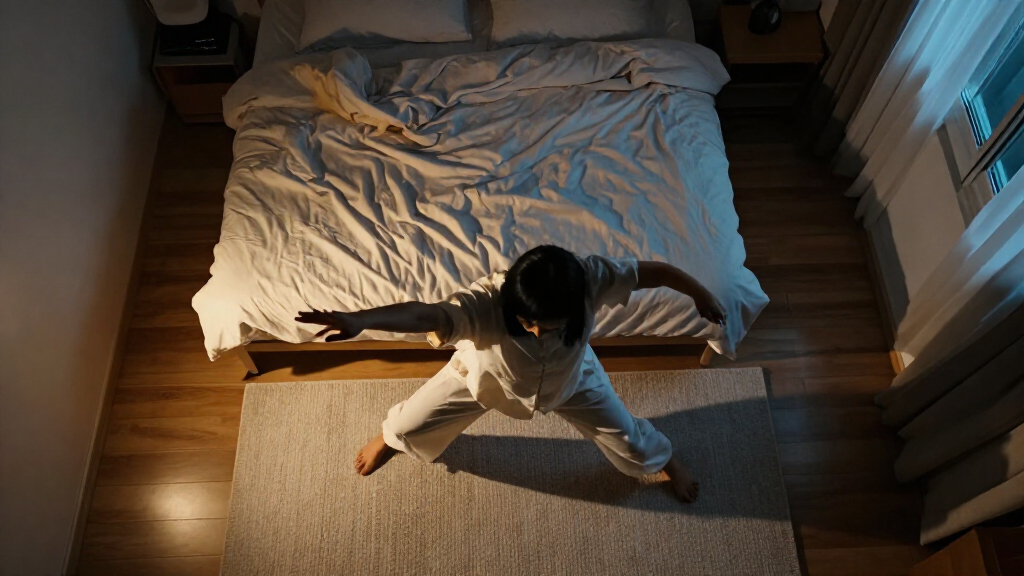
Next, stand with feet about shoulder-width apart and knees slightly bent. For the “Lift water” movement, gently raise relaxed arms to shoulder height while inhaling, turn the palms forward and lower the arms. The routine then moves into silk-reeling movements: turning the waist, shifting weight between legs and moving one hand in a slow, circular pattern before coordinating both hands. The source advises moving gradually and matching movement to breathing.
To finish, sit or stand beside the bed and massage the neck, arms, midsection and legs. Thompson’s sequence also includes lightly patting those areas with cupped hands. The article presents these as relaxation movements, not as a treatment for insomnia or another health condition.
A Brief Routine Before Bed
The routine gives readers a short, structured way to pause at the end of the day, using movements that can be done at home and do not require equipment. Its seated opening and gentle standing exercises also offer different levels of movement, though the standing portion requires balance and a safe space.
Thompson’s explanation is a teacher’s recommendation, not evidence that the routine will work for everyone. Fit&Well’s report does not cite a trial of this five-minute sequence or quantify any effect on sleep. Readers can treat it as a possible relaxation practice, while avoiding the assumption that it will prevent or resolve persistent sleep problems.
massage roller for neck and shoulders
As an affiliate, we earn on qualifying purchases.
As an affiliate, we earn on qualifying purchases.
What the Sequence Includes
Fit&Well describes Tai Chi as an ancient Chinese practice built around gentle movement and a mind-body connection. The particular bedtime sequence in the report is attributed to Thompson, identified as a Tai Chi teacher and founder of BNEW4LIFE. The source does not provide further details about his credentials or describe how the routine was evaluated.
The exercises progress from low-effort breathing to standing movements and then massage. In the silk-reeling section, the practitioner first works one side, then changes sides and brings both arms into the pattern. The report suggests keeping the shoulders relaxed, the spine upright and the knees slightly bent. These directions describe the routine; they do not establish that each movement has a specific physiological effect.
“The benefit of an evening Tai Chi practice is that it helps to unwind accumulated physical tension in the back, neck and shoulders from the day.”
— Brian Thompson, Tai Chi teacher and founder of BNEW4LIFE, as quoted by Fit&Well
Sleep Effects Are Unverified
The Fit&Well report does not identify a study, clinical trial or measured sleep outcome for this particular routine. It is not clear whether the practice improves sleep duration, how quickly someone might notice a change, or whether it has the same effect for different people. Thompson’s description of nervous-system and sleep effects should be understood as an attributed explanation, not as proof that the routine will produce those results.
The article also does not specify modifications for people with limited mobility, balance difficulties or pain. Anyone for whom standing or weight-shifting movements feel unsafe can stop or avoid those movements. Persistent sleep difficulties may have causes that a brief relaxation routine cannot address.
How Readers Can Try It
The report offers the sequence for readers to try in the evening: begin with one to two minutes of seated breathing, continue through the gentle arm lifts and silk-reeling movements, then finish with massage and light cupping. It does not set out a follow-up schedule or claim that the practice must be repeated for a particular number of nights.
Fit&Well provides no planned study or further update on the routine’s effects. The next step for readers is therefore personal: try the movements only if comfortable, keep expectations measured and seek advice from a qualified health professional if sleep problems persist or raise concerns.
Key Questions
What is the five-minute Tai Chi routine?
It is a sequence described by Fit&Well that starts with seated breathing, continues with gentle arm lifts and silk-reeling movements, and ends with massage and light patting.
Does the routine have proven sleep benefits?
The source does not report clinical evidence testing this specific routine or measured results. Its suggested benefits are attributed to Tai Chi teacher Brian Thompson.
Do I need equipment to try it?
The instructions call for a sturdy chair and enough clear space to stand and move. No other equipment is specified.
What if standing movements are uncomfortable?
Do not continue movements that feel unsafe or painful. The routine begins seated, but the source does not give tailored modifications; a qualified professional can advise on suitable activity for individual needs.
Can this replace help for ongoing sleep problems?
The report presents the practice as a way to unwind, not as treatment for insomnia. If sleep difficulties persist, consider speaking with a qualified health professional.
Source: rss
Evergreen bestsellers Picks
bestsellers
As an affiliate, we earn on qualifying purchases.