
TL;DR

Turn your wind-down time into listening time
- Thousands of audiobooks, podcasts and originals
- Listen on your phone, tablet or Echo — also offline
- Cancel anytime
A Fit&Well report recommends four exercises for building strength and balance: a seated knee lift with sit-to-stand, a dumbbell hold with leg raise, a farmer carry and a shoulder press. The routine is presented as a practical way to train movements used in daily life, but the source does not provide trial evidence that it prevents falls or guarantees independence.
Fit&Well has published a four-exercise strength and balance routine for older adults, pairing chair-based movements with dumbbell exercises to train tasks such as standing from a seat, carrying groceries and reaching overhead. The instructor behind the routine recommends two rounds, with eight repetitions of each exercise, except for a 30-second farmer carry.
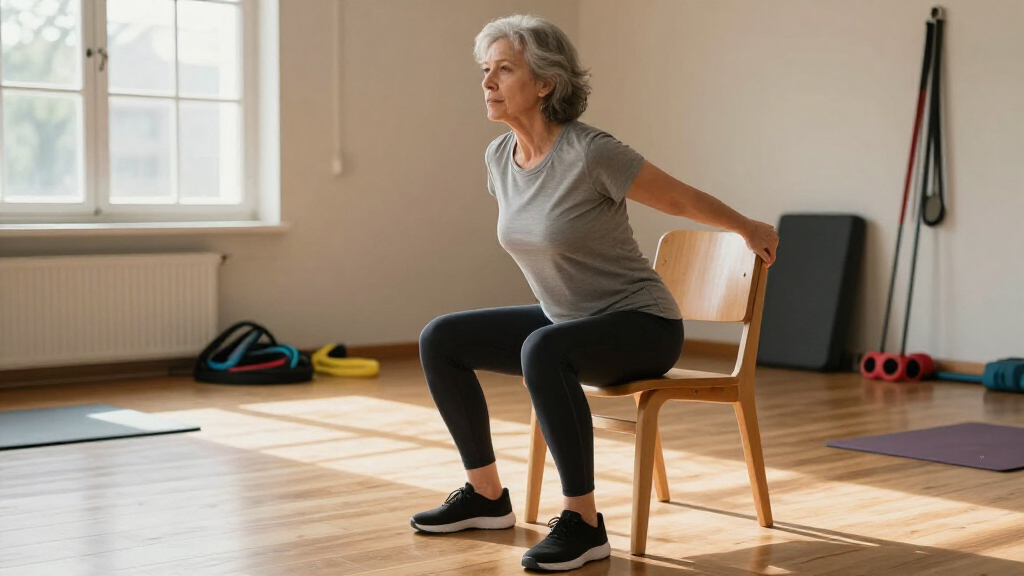
The routine begins with a seated knee lift and sit-to-stand. From a sturdy chair, the exerciser lifts each knee in turn, then stands and sits back down with control. The report says the knee lifts work the hip flexors, while the sit-to-stand targets the thighs and glutes—muscles used when rising from a low seat or getting out of a car.
Next is a dumbbell hold with a side leg raise: hold one weight in one hand, raise the opposite leg out to the side without leaning, then switch. The report describes the one-sided movement as a way to challenge balance while the hips and core help steady the body. The third exercise, the farmer carry, involves walking for 30 seconds while holding a dumbbell in each hand, with an upright torso and controlled steps.
The final movement is a shoulder press, performed seated or standing. Hold dumbbells at shoulder height, press them overhead while keeping the torso steady, and lower them slowly. Fit&Well advises using a sturdy chair and weights that can be controlled throughout each movement. Its suggested dose is eight repetitions per exercise, per side where applicable, for two rounds; the carry is done for 30 seconds, with 30 seconds of rest listed between carries.
Training for Everyday Independence
The routine is organized around daily actions rather than athletic performance: standing from a chair, moving the legs, walking with loads and lifting objects overhead. That framing may help readers connect strength and balance work to practical goals, including carrying shopping or managing transfers in and out of a car.
The instructor says she has heard from class participants about changes they associate with strength training, including easier car transfers and longer walks. Those accounts are personal examples, not controlled evidence that this particular four-move routine produces the same results for others. The report also does not establish that the exercises prevent falls, treat health conditions or preserve independence on their own.
Its broader message is that practicing relevant movements before later life may support physical capacity over time. The article specifically encourages readers to build strength in their 40s and 50s as preparation, while describing classes attended by people from their late 60s into their 90s.
As an affiliate, we earn on qualifying purchases.
How the Routine Is Structured
The report is written by an instructor who teaches chair workout classes for older adults. She says participants attend with a shared aim of staying independent and gives examples of tasks they want to manage, such as walking farther, carrying groceries and reaching high shelves.
Those experiences provide the article’s rationale for choosing the four movements: each is linked to a recognizable task. The report mentions one participant whose upper-body strength was remarked on by a nurse after hip replacement surgery, but provides no medical record or independent verification of that account. It should be read as the instructor’s anecdote, not evidence about surgical recovery.
The routine requires a sturdy chair and a pair of dumbbells. It does not specify a starting weight, a progression schedule or modifications for particular medical or mobility needs. Readers considering exercise changes for health reasons should seek guidance from a qualified health professional or exercise specialist familiar with their circumstances.
Evidence and Individual Suitability
The supplied report does not cite a clinical study testing these four exercises as a package, nor does it quantify effects on strength, balance, falls or independence. The instructor’s class experiences are anecdotal, and the source does not give details about how participants’ progress was measured.
It is also unclear whether the routine is suitable without adjustment for people with pain, balance limitations, recent surgery or other health concerns. The report gives no specific weight range, chair specifications beyond “sturdy,” or instructions for adapting the movements. The recommended repetitions and rounds are the article’s suggested routine, not a personalized prescription.
How Readers Can Use the Routine
The Fit&Well article offers the sequence and basic instructions, but the supplied source names no follow-up study, program or scheduled update. Readers who want to try the movements can follow the stated two-round format only if they can perform them safely and control the weights; individual adjustments may be needed.
For people uncertain about balance, strength, pain or suitable loads, the practical next step is to ask a qualified health professional or an appropriately trained exercise instructor for guidance. The report does not say that completing the routine alone will prevent falls or guarantee continued independence.
Key Questions
What are the four exercises in the routine?
The routine includes a seated knee lift and sit-to-stand, a dumbbell hold with a side leg raise, a farmer carry and a shoulder press.
How many repetitions and rounds does the report recommend?
Fit&Well recommends eight repetitions of each exercise, per side where relevant, for two rounds. The farmer carry is held for 30 seconds, with 30 seconds of rest listed.
What equipment is needed?
The report calls for a sturdy chair and a pair of dumbbells. It advises choosing weights that can be controlled throughout each movement, but does not specify a weight range.
Does this routine prevent falls or guarantee independence?
No such outcome is established in the supplied report. It presents exercises intended to challenge strength and balance, along with the instructor’s personal observations, but does not cite research showing this routine prevents falls or guarantees independence.
Source: rss
Halloween Picks
halloween
As an affiliate, we earn on qualifying purchases.