
TL;DR

Turn your wind-down time into listening time
- Thousands of audiobooks, podcasts and originals
- Listen on your phone, tablet or Echo — also offline
- Cancel anytime
Fit&Well published a yoga therapist’s seven-part seated movement sequence for older adults, including people with movement disorders or chronic health conditions. The routine uses a sturdy chair and offers adjustments, but the report does not establish clinical benefits or provide individualized medical guidance.
Fit&Well has published a seven-part chair exercise sequence recommended by a yoga therapist who works with older adults, including people living with Parkinson’s disease, other movement disorders and chronic health conditions. The therapist presents the gentle movements as an accessible way to stretch and mobilize the body from a seated position, while advising participants to stay within their own range and capacity.
The sequence begins with a minute of settling into a sturdy chair, feet flat on the floor and hands resting in the lap. The therapist advises sitting toward the back of the chair for support, keeping the chest upright and allowing the breath to settle naturally. The remaining movements coordinate breathing with upper-body motion.
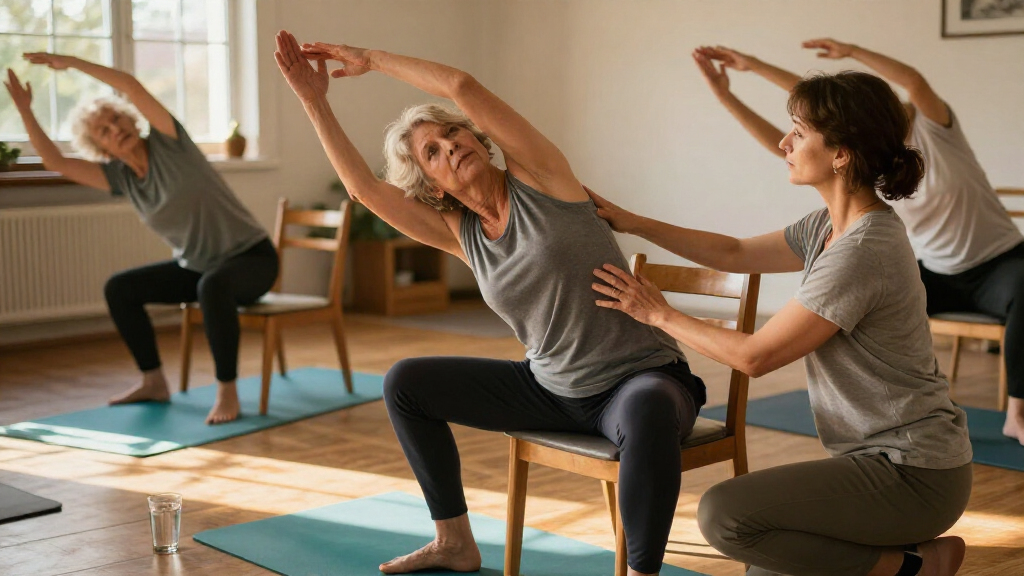
Participants are guided through arm arcs into prayer, seated torso twists, single- and double-arm raises, side bends, a seated cat-cow movement and forward folds. The instructions generally call for three to five repetitions, or three repetitions on each side, depending on the movement. The sequence requires enough room to raise the arms comfortably.
The report includes adjustments: during a side bend, a participant can hold the side of the chair for stability instead of reaching an arm down. For the forward fold, hands can stay on the knees for added support. Looking upward during arm raises is optional. The therapist’s central instruction is to explore accessible movement rather than trying to achieve a particular pose.
Seated Movement With Built-In Options
The routine is presented for people who may find floor-based exercise inaccessible or simply prefer to move from a chair. That makes its practical focus clear: the movements can be done seated, with a chair serving as both the exercise setting and a source of support. The therapist says the approach is used with older adults who have movement disorders and chronic conditions, though the article does not say the sequence is appropriate for every person with those conditions.
The instructions also give readers ways to reduce the reach or add stability, rather than treating every movement as a fixed shape. That may help make the sequence easier to adapt, but it is not evidence that the routine produces a particular health outcome. The report offers no trial data, measured results or comparison with other exercise programs.
Products Worth Considering

Oral-B iO Series 3 Rechargeable Electric Toothbrush for Adults, Black

Oral-B iO Series 9 Limited Rechargeable Electric Toothbrush with 7 Cleaning Modes

Garmin Venu® 3 Premium Fitness Smartwatch 45mm Black
As an affiliate, we earn on qualifying purchases.
A Yoga Therapist’s Seated Approach
In the Fit&Well report, the therapist describes using chair-based yoga with people who do not have the mobility for floor-based movement and with people who feel more comfortable exercising from a chair. The practice is described as mindful movement, combining stretching and joint movement with attention to breathing and bodily sensations.
The therapist says the postures are gentle because many participants are older adults with Parkinson’s, other movement disorders or chronic health conditions. The article presents the sequence as an example readers can try with a sturdy chair; it does not specify a clinical protocol or say that a particular diagnosis is required to use it.
““I encourage everyone to move within the range and capacity of their body—there’s no particular shape or position to achieve.””
— The yoga therapist quoted in Fit&Well
Limits of the Published Guidance
The source does not provide a publication date in the supplied material, nor does it identify clinical research testing this specific seven-movement sequence. It also does not report how many people have tried it or measure changes in balance, mobility, mood or other health outcomes.
The article does not set out screening criteria, explain how to adapt every movement for different limitations, or say what a reader should do if an exercise causes pain, dizziness or discomfort. Its general advice is to stay within personal capacity, but individual suitability cannot be determined from the report alone. People with health concerns should seek guidance from a qualified health professional before making exercise decisions.
How Readers Can Use the Sequence
The next step described in the report is simply to try the sequence using a sturdy chair and adequate space, following the repetition ranges and optional modifications. Readers can leave out movements or reduce their range to suit what feels accessible, rather than attempting to match a prescribed pose.
Fit&Well’s report does not announce a follow-up study, new program or clinical evaluation. Further evidence about effectiveness, safety for particular conditions and the best adaptations would require information beyond the material published in the article.
Key Questions
What exercises are included in the chair sequence?
The sequence includes a brief seated settling exercise, arm arcs into prayer, torso twists, single- and double-arm raises, side bends, seated cat-cow movements and forward folds.
What equipment is needed?
The report calls for a sturdy chair and enough space around it to raise the arms comfortably. It does not list other equipment.
Can the movements be modified?
Yes. The instructions suggest holding the chair during side bends for stability and keeping hands on the knees during forward folds for support. Looking up during arm raises is optional, and the therapist advises moving within personal capacity.
Does the article prove the routine improves health?
No. The report shares a therapist’s recommended sequence and descriptions of class participants’ experiences, but it provides no research results or measured health outcomes for this routine.
Is the sequence suitable for everyone with a chronic condition?
The article does not establish that it is suitable for every person or condition. Anyone with health concerns should consult a qualified health professional about exercise choices and personal limitations.
Source: fitandwell.com