TL;DR

Turn your wind-down time into listening time
- Thousands of audiobooks, podcasts and originals
- Listen on your phone, tablet or Echo — also offline
- Cancel anytime
Fit&Well reports that beginners can start building upper-body strength at home with bodyweight movements, without buying weights or joining a gym. Physical therapist Nicholas Rolnick recommends an extended-arm plank, knee push-ups and prone swimmers, with easier versions for people who cannot yet complete the full movements.
Fit&Well has outlined three no-equipment exercises for beginners looking to start building upper-body strength at home: an extended-arm plank, knee push-ups and prone swimmers. The routine draws on advice from physical therapist and strength and conditioning specialist Nicholas Rolnick, who says weight-bearing bodyweight movements can provide a useful strength stimulus for people new to exercise.
Rolnick, founder of The Human Performance Mechanic in Manhattan, recommends the three movements as a starting point. The report suggests one plank hold for up to one minute, with the option to begin on the knees, followed by three sets of three to five knee push-ups and three sets of five prone swimmers. These are the source’s suggested starting amounts, not a personalized program.
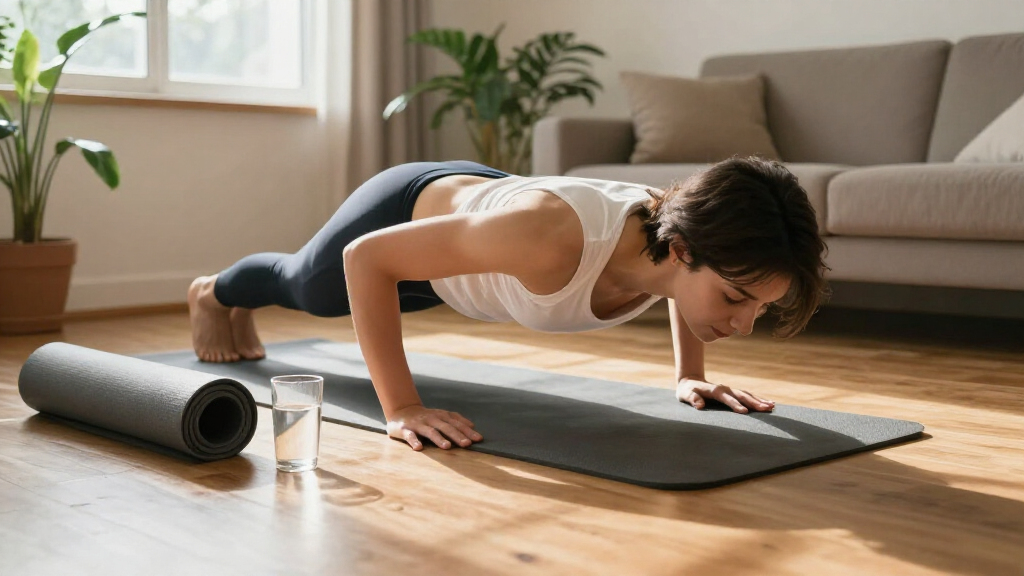
For the plank, begin on hands and knees, with wrists beneath the shoulders, then extend the legs so the body forms a line from head to heels. Keep feet about hip-width apart, brace the core, squeeze the glutes and press the floor away. People who cannot maintain the full position can keep their knees down and work toward a one-minute hold.
For knee push-ups, place the hands slightly wider than shoulder-width and walk them forward until the body is straight from head to knees. A rolled towel or yoga block can mark how far to lower the chest. Bend the elbows close to the body, pause for two to three seconds, then press back up. If pressing up is too difficult, Rolnick’s guidance is to practice the lowering phase slowly. For prone swimmers, lie face down and sweep the arms from the sides, out to shoulder level and then forward, keeping them raised during the movement. The report suggests breaking this into five to 10 lifts at each position if the full sweep is challenging.
A Low-Cost Starting Point at Home
The routine addresses a common barrier to beginning strength training: access to equipment or a gym. It offers readers three movements that use bodyweight alone, with scaled options intended to make the exercises more approachable. That can help a beginner start practicing basic positions and movement patterns without first purchasing weights.
Rolnick’s rationale, as reported by Fit&Well, is that weight-bearing movements require the body to create stability as well as produce force. He says that co-contraction and stability can contribute to a stimulus for improving muscle strength. This is an expert’s explanation of why he recommends these exercises; the article does not report results from a clinical trial comparing this routine with other programs.
The practical takeaway is modest: the exercises provide a possible entry point, not a guarantee of a particular outcome. Difficulty can be adjusted by changing the plank position, lowering only during a push-up, or splitting the swimmer movement into parts. Individual ability and comfort will vary.
Products Worth Considering

Oura Ring 5 Smart Ring, Silver, Size 8

Fitbit Inspire 3 Health and Fitness Tracker Bundle

Bowflex SelectTech 840 Adjustable Kettlebell
As an affiliate, we earn on qualifying purchases.
Rolnick’s Three Exercise Choices
Fit&Well presents the exercises as beginner options rather than as a complete, individualized training plan. The extended-arm plank emphasizes holding a stable position through the shoulders and trunk. The knee push-up adapts a familiar pressing exercise by keeping the knees on the floor, while the prone swimmer uses a face-down arm sweep instead of equipment-based pulling movements.
The report’s prescribed amounts are specific: a one-minute plank goal, three sets of three to five knee push-ups, and three sets of five prone swimmers. It also gives regressions for each exercise. A knee-supported plank can precede a full plank; a slow lowering phase can precede a full knee push-up; and swimmers can be divided into arm positions. These adjustments are part of the source’s advice and are not evidence that every reader should use the same schedule or progression.
“For beginners, the biggest bang-for-your-buck upper-body exercises are going to involve mostly weight-bearing [moves].”
— Nicholas Rolnick, physical therapist and strength and conditioning specialist, as quoted by Fit&Well
Limits of the Routine’s Guidance
The source material does not specify how many days per week to perform the exercises, how long to rest between sets, or when to increase repetitions or move to harder variations. It also does not report measured strength gains or compare the routine with other training plans. The recommended sets and repetitions should therefore be understood as starting guidance from Rolnick, not a proven schedule for every person.
The report does not provide individualized advice for people with injuries, pain, medical conditions or other exercise limitations. A reader’s ability to perform the movements safely may depend on their circumstances. Anyone unsure whether an exercise is appropriate can seek guidance from a qualified health or fitness professional.
How Beginners Can Progress
The next step described in the report is to use the easier versions until the movements feel manageable: hold the plank from the knees, practice the controlled lowering part of a knee push-up, and divide prone swimmers into separate arm positions. From there, readers can work toward the full versions while keeping the movements controlled. Fit&Well does not set a progression timetable, so when to advance is left open.
The report provides no follow-up results or announcement of a later update. Readers seeking a more complete plan would need further guidance on weekly frequency, rest and progression, or advice tailored to their needs.
Key Questions
Can I start building upper-body strength without weights?
Fit&Well’s report says beginners can start with bodyweight exercises. It recommends an extended-arm plank, knee push-ups and prone swimmers, while noting that individual results are not specified.
How many knee push-ups does the report suggest?
Rolnick’s suggested starting amount is three sets of three to five repetitions. The report advises practicing a slow lowering phase if pressing back up is not yet manageable.
What if I cannot hold a full plank?
The report suggests keeping the knees on the floor and building toward a one-minute hold before trying the full plank position.
How can I make prone swimmers easier?
Fit&Well advises breaking the arm sweep into positions. Try five to 10 lifts in each position—arms by the sides, out at shoulder level and then pointing forward—rather than completing the full movement.
Does the report say how often to do the routine?
No. The supplied report lists sets, repetitions and a plank time, but does not give a weekly schedule, rest periods or a timeline for increasing difficulty.
Source: fitandwell.com