
TL;DR

Turn your wind-down time into listening time
- Thousands of audiobooks, podcasts and originals
- Listen on your phone, tablet or Echo — also offline
- Cancel anytime
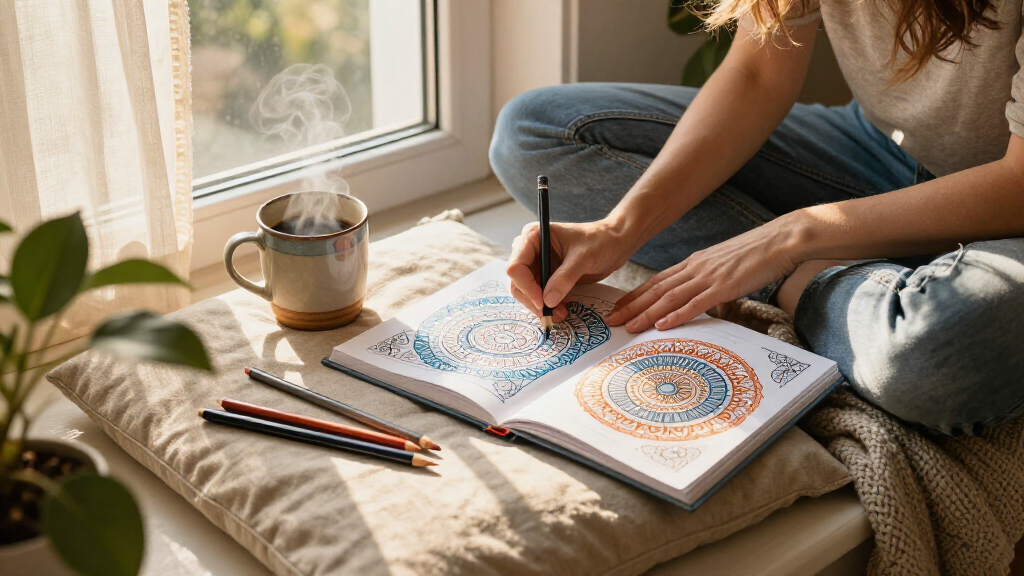
Adult coloring books reduce anxiety by giving your brain a simple, structured task that quiets threat-monitoring activity — a 2015 study by Curry and Kasser found that coloring mandalas or geometric patterns lowered anxiety more than free-form drawing. Coloring is not therapy, but a 10–20 minute daily session with the right book and pencils is a low-cost, screen-free way to unwind.
You’ve had one of those days. Emails stacking up, phone buzzing, brain doing laps around a worry it can’t drop. Then you sit down, open a coloring book, and twenty minutes later your shoulders have dropped two inches and your thoughts have stopped sprinting.
That’s the promise of stress relief adult coloring books — and unlike most wellness trends, there’s actual research behind it. The boom started around 2015, when titles like Johanna Basford’s Secret Garden sold millions of copies worldwide and turned coloring into a legitimate adult pastime [1].
In this article, you’ll learn what the science actually says, which book styles calm your brain most, how to pick supplies without wasting money, and how to build a coloring routine that sticks.
Structured designs — mandalas and geometric patterns — reduce anxiety more than free-form coloring, per the Curry & Kasser (2015) study.
Aim for 10–20 minute sessions; consistency matters more than finishing pages or marathon sessions.
Colored pencils are the safest starter tool; if you use markers, your book needs 80+ gsm paper or single-sided pages to prevent bleed-through.
Coloring is a self-care tool, not a treatment — if anxiety or low mood disrupts your life, see a qualified professional.
Paper books beat coloring apps for stress relief because they deliver the screen-free break that’s central to the benefit.
Do Adult Coloring Books Actually Reduce Stress? Here’s the Honest Science
Adult coloring books reduce stress for many people, but the evidence is promising rather than dramatic. The most-cited study on the subject, Curry & Kasser (2015), found that participants who colored mandalas or plaid patterns for about 20 minutes showed measurably lower anxiety than those who colored freely on blank paper [1].
Why does structure matter? The theory is that a repetitive, rule-bound task occupies the brain’s threat-monitoring system — the same circuitry that lights up when you’re anxious — and gives it something harmless to chew on. It’s similar in effect to meditation, but easier for people who can’t sit still and “clear their minds.”
Think of it like a screen saver for your brain. Your anxious thoughts can’t run wild when half your mental bandwidth is busy deciding whether that petal should be coral or salmon.
Reported benefits in the research literature include reduced anxiety, improved focus, mild mood improvement, and a screen-free break from devices [1]. One honest caveat, though.
Coloring is not a substitute for therapy or treatment for clinical anxiety or depression. It’s a self-care tool — a good one, but a small one. If stress is interfering with your daily life, talk to a qualified mental health professional.
Why Mandalas Beat Free-Form Coloring for Calming Your Brain
Mandalas and geometric patterns calm anxiety better than open-ended drawing because symmetry removes decisions. Every choice you don’t make — composition, proportion, subject — is mental bandwidth you get back for relaxing.
The Curry & Kasser study made exactly this point: mandala coloring outperformed free-form coloring on anxiety reduction [1]. A blank page asks “what should I create?” A mandala asks “which green next?” That second question is the one your tired brain wants.
Picture the difference. Free-form drawing can feel like a performance review — is my tree good enough? Coloring inside an intricate pattern has no failure state. Worst case, you pick a color combination you don’t love. The stakes are deliciously low.
This doesn’t mean detailed books are always better, though. If you’re a beginner, hyper-intricate designs with millimeter-wide spaces can create the opposite of calm. Match complexity to your patience level, and lean toward symmetry when you want the meditative effect.
Which Coloring Book Should You Buy? A Quick Guide by Style
The best stress relief coloring book depends on your taste, but symmetrical and nature-themed designs have the strongest connection to calming benefits. Here’s how the main styles compare.
| Style | Best For | Watch Out For |
|---|---|---|
| Mandalas & geometric patterns | Meditative, anxiety-focused coloring | Can feel repetitive over long sessions |
| Botanicals & nature scenes | Relaxing detail work; Basford-style fans | Often intricate — not beginner-friendly |
| Licensed themes (Harry Potter, etc.) | Fans who want familiarity | Pricier; quality varies by publisher |
| Humor & swear-word books | Stress relief with laughs; great gifts | Simple designs, less meditative |
| Affirmation & gratitude hybrids | Combining coloring with journaling | Less pure coloring content per book |
If you’re new, start with a mid-complexity mandala or botanical book. Johanna Basford’s Secret Garden (2013) is the classic for a reason — it helped kick off the entire 2015 boom when it sold millions of copies [1].
One buying tip that saves headaches: check for single-sided pages or perforated tear-out edges. You’ll thank yourself the first time you want to frame (or gift) a finished page.
Colored Pencils vs. Markers vs. Gel Pens: What’s Worth Your Money
Colored pencils are the best all-around choice for adult coloring books because they offer control, blending, and zero bleed-through risk. Markers deliver the most vibrant color but demand better paper; gel pens sit somewhere in between.
- Colored pencils — best for detail and layering. Sharpen often. A basic 24–36 set under $15 handles almost everything.
- Gel pens — vibrant and smooth, lovely for accents. Watch for smudging before you close the book.
- Markers — bold, fast coverage. Always test on a back page first; alcohol markers will go straight through thin paper.
- Watercolor & pastels — beautiful special effects, but only for books with thick, one-sided pages.
Here’s the paper rule that matters most: markers want 80 gsm paper or thicker (ideally one-sided pages). If your book doesn’t say, slide a scrap sheet behind the page you’re coloring. Cheap insurance.
Real-world example: a friend bought a bargain coloring book and a set of alcohol markers, then discovered every page bled through onto the next design. Two ruined pages later, she switched to pencils and never looked back. Total kit cost: about $25. That’s cheaper than a single massage.
How to Build a Coloring Routine That Actually Sticks (10–20 Minutes a Day)
A 10–20 minute daily coloring session is enough to get the calming benefits, based on the session lengths used in the anxiety research. Here’s a simple routine to make it a habit rather than a one-week experiment.
- Pick a fixed time — after dinner or before bed works well, when your brain needs a wind-down cue.
- Set out supplies in advance — book open, pencils within reach. Friction kills habits.
- Put your phone in another room — the digital detox is half the benefit.
- Set a timer for 15 minutes — no pressure to finish a page. One mandala can take days; that’s fine.
- End while you’re still enjoying it — stop before it feels like a chore, and you’ll want to return tomorrow.
Consistency beats duration. Five calm sessions a week will do more for your stress than one marathon Sunday coloring sprint that leaves you with a cramped hand and a half-finished forest.
And no, you don’t need talent. Nobody is grading your color choices. The process is the product.
Are Coloring Apps as Good as Paper? (One Honest Downside)
Coloring apps like Pigment and Colorfy are convenient and grew substantially after 2020, but they lose the main benefit of paper coloring: being away from a screen. Tap-to-fill is faster, but the tactile, slow work of pencil on paper is what occupies your hands and calms your nervous system.
The post-2020 surge in at-home stress relief boosted both formats [1]. If you travel a lot or don’t want to carry supplies, an app is a reasonable compromise. Just don’t expect the same unplugged reset.
Think of it like the difference between a driving simulator and actually driving. The inputs are similar; the experience isn’t. If screen time is part of your stress problem — and for most of us it is — paper wins.
A hybrid approach works too: keep a small book and a travel pencil set in your bag for commutes or waiting rooms, and use an app only when carrying supplies is genuinely impractical.
Frequently Asked Questions
Do adult coloring books really help with anxiety?
Yes, moderately. A 2015 study by Curry and Kasser found that coloring mandalas or geometric patterns reduced anxiety more than free-form coloring [1]. Coloring gives the brain’s threat-monitoring system a simple task, producing a meditation-like effect. It’s a helpful self-care tool, not a replacement for therapy or treatment of clinical anxiety.
How long should I color to feel the benefits?
About 10–20 minutes per session, which matches the durations used in anxiety research. Daily short sessions work better than occasional long ones. You don’t need to finish a page — stop while you’re still enjoying it.
What supplies should a beginner buy?
Start with a mid-complexity mandala or botanical book with single-sided pages and a 24–36 count set of colored pencils. That’s roughly $25 total. Add gel pens or markers later if you want bolder color — just test markers on a back page first to check for bleed-through.
Why are mandalas recommended for stress relief specifically?
Mandalas combine symmetry with repetition, which removes creative decisions and lets your brain settle into a rhythmic, meditative state. The Curry & Kasser study found mandala coloring reduced anxiety more than unstructured coloring on blank paper [1].
Are coloring apps as effective as physical books?
Apps like Pigment and Colorfy are convenient, but they lose the key benefit of paper coloring: being away from screens. The tactile, slow pace of pencil on paper is a big part of why coloring calms the nervous system. Use apps as a backup for travel, not your main tool.
Conclusion
If you take one thing from this: pick a symmetrical design, grab pencils, and give it 15 minutes today — ideally with your phone in another room. That’s the whole formula. The science says the effect is real but modest, so let coloring be the appetizer for calm, not the whole meal.
Tonight, instead of scrolling until your eyes ache, try filling in one petal, one leaf, one tiny triangle. Your brain will thank you for giving it something gentle to do.
Halloween Picks
halloween
As an affiliate, we earn on qualifying purchases.